
Same Script, Different Cast: Why Organizations Keep Hiring Toxic Leaders
Dr. Celia McIntosh, DNP, FNP-C, PMHNP-BC


I often find myself reflecting: am I the problem? After all, I am the common denominator in this equation.
After more than 12 years of watching leaders come and go in a revolving door of dysfunction, it’s hard not to internalize the chaos around me. I’ve worked with more than 30 neurologists, 16 advanced practice providers, and at least seven leaders.
It often feels like I’m stuck on a sinking ship.
The Sinking Ship
Despite the turnover, the pervasive and toxic traits of those in leadership—narcissism, favoritism, a "god complex," backbiting, sarcasm, and dismissive tendencies—remained constant.
Why do organizations continue to hire leaders with these toxic traits? It’s like they wear a sign that says “apply here if toxic.” These organizations can be so toxic that it feels like you’re on a sinking ship, plagued by poor leadership, dysfunction, and a toxic culture that drives people away.
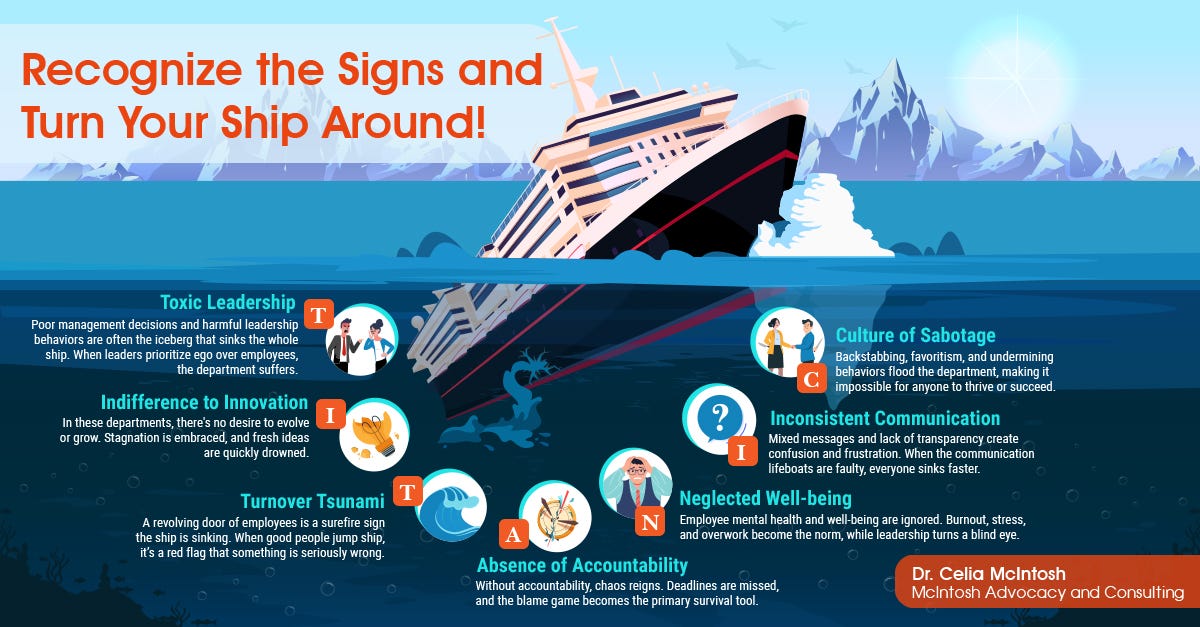
Ships don’t sink themselves. The water that gets into them sinks them. Similar to the Titanic, many of these organizations leave toxic leadership to steer the organization, developing systemic failures, indifference to innovation, absence of accountability, neglected well-being of their employees, inconsistent communication, and a culture of sabotage.
Why does this pattern persist? Why does the script stay the same when the cast changes, perpetuating the cycle? Organizations often fall into the trap of hiring toxic leaders because they focus on superficial attributes like confidence, charisma, and ambition. These qualities can easily be mistaken for leadership potential.
Ships don’t sink themselves. The water that gets into them sinks them.
If you peel back the layers, similar to an onion, you often find these surface-level traits often have deeper roots of dysfunction. If these behaviors go undetected, like a match, behaviors will eventually start to burn and erode the organization. This problem stems from a bigger and more complex problem and requires more comprehensive solutions, but these organization often don’t want to do the work to make the substantial changes it need for the organizational health.
Predictors of Toxic Leadership
Narcissistic traits
Narcissists exude confidence and self-assurance, which makes them seem like strong candidates for leadership positions. Moreover, these traits are often masks for deeper dysfunctions, such as manipulation, a lack of empathy, and unethical decision-making. According to Jonason et al., leaders exhibiting narcissism, Machiavellianism, and psychopathy are more likely to create hostile work environments, exploit employees, and foster toxic cultures (2012). Despite their ability to “play the part” and trick the managers, these leaders are often ill-equipped to meet the psychological needs of their teams or contribute in a meaningful way, especially when their interests are self-serving and not mission-driven. The lack of emotional intelligence ultimately contributes to discord, burnout, and high turnover.
Toxic leaders undermine basic psychological needs. By micromanaging employees, playing favorites, and fostering an atmosphere of distrust, these “leaders” strip employees of their autonomy, reduce their sense of competence, and erode their sense of belonging. In doing so, they sabotage employee engagement, productivity, creativity, and job performance. Research by Martela et al. highlights how supporting these needs in employees leads to intrinsic motivation, greater work engagement, and meaningful work experiences (2019). Effective leaders play a crucial role in creating environments that satisfy these needs by offering autonomy-supportive environments, recognizing employee contributions, and fostering collaboration and belonging within teams (Ryan, Deci, & Vansteenkiste, 2016).
Overemphasis on “cultural fit,” not “organizational health”
Many organizations hire leaders who align with the current company culture, even if that culture is unhealthy or dysfunctional. Like the Titanic’s crew who ignored multiple iceberg warnings, organizations often overlook the signs of a toxic leader if that person appears to fit into the existing power dynamics or reinforces the status quo.
Toxic leaders thrive in environments where exclusion, favoritism, and unhealthy competition are normalized. This short-sighted focus on cultural alignment leads to long-term damage, preventing the organization from fostering a healthy, inclusive culture that supports employee well-being and performance.
The halo effect
Another common issue is the halo effect, a cognitive bias where a hiring manager’s overall impression of a candidate overshadows potential red flags. If a leader appears charismatic or successful, decision-makers may overlook traits like narcissism or manipulation, which later contribute to toxic work environments. In high-pressure industries where aggressive behaviors are often excused or even rewarded, this bias becomes particularly dangerous. Without rigorous, evidence-based hiring practices, organizations leave themselves vulnerable to repeatedly hiring toxic leaders.
Steering the Ship into Danger
Just like the Titanic, these organizations often believe they’re unsinkable—that they can weather the storm despite ignoring multiple red flags. Toxic leaders, much like the overconfident crew of the Titanic, steer the organization directly into danger. When strong leadership is absent, the ship lacks direction. There is no course correction, and employees are left adrift, struggling to stay afloat in a toxic culture.
Leaders with a "god complex" believe they can steer the ship through sheer willpower, ignoring the clear warning signs of burnout, disengagement, and high turnover. Instead of changing course, they blame others or double down on their harmful behaviors, pushing the organization further into dysfunction. When toxic leaders are at the helm, it’s only a matter of time before the organization hits its own iceberg—a crisis in morale, performance, or even public relations—that sinks the entire culture.
How Organizations Can Change Course
To stop the repeated hiring of toxic leaders, organizations must implement several key strategies focused on long-term health, accountability, and leadership development.
Comprehensive hiring practices
Organizations must move beyond superficial interviews and implement more comprehensive hiring practices that assess emotional intelligence, empathy, and leadership style. Tools such as personality assessments (e.g., the Hogan Personality Inventory) and structured behavioral interviews can help identify red flags before a candidate is hired (Hogan & Hogan, 2001). Additionally, 360-degree feedback from previous colleagues and employees can provide a fuller picture of the candidate’s leadership style.
Focus on inclusivity, emotional intelligence, and accountability
Rather than hiring leaders based solely on cultural fit, organizations should focus on long-term health by selecting leaders who foster inclusivity, emotional intelligence, and accountability. Leaders who prioritize intrinsic motivation—fostering autonomy, competence, and relatedness—create a thriving workplace culture (Deci & Ryan, 1985). By reforming hiring practices to prioritize organizational health, organizations can break free from cycles of toxic leadership.
Accountability is critical in preventing toxic leadership. Organizations must implement robust feedback systems, including anonymous employee surveys and leadership evaluations that go beyond performance metrics. Leaders should be evaluated on how well they support employee autonomy, competence, and relatedness, ensuring that they foster a positive and inclusive work environment (Tepper, 2000).
As a thought leader, I am committed to raising awareness about the predictors of toxic leadership and advocating for evidence-based hiring and accountability practices. Organizations can break the cycle of hiring toxic leaders by prioritizing emotional intelligence, ethical decision-making, and long-term cultural health. Through my consulting work, I emphasize the importance of creating environments that value empathy, integrity, and transparency.
Additionally, I aim to raise awareness about the psychological and physiological tolls that toxic leadership takes on employees. Drawing on research about stress and allostatic load, I hope to inspire other leaders to take proactive steps in preventing toxic cultures from developing. By sharing both my personal experiences and the science behind workplace toxicity, I hope to foster healthier, more resilient organizations.
Ignoring the predictors of toxic leadership is costly for both organizations and employees. High turnover, reduced productivity, and a toxic workplace culture are the inevitable outcomes when toxic leaders are allowed to thrive. By recognizing the warning signs—narcissism, manipulation, and a focus on short-term cultural fit—organizations can implement the changes needed to prevent toxic leadership from taking root. As a thought leader, I will continue to advocate for leadership practices that prioritize emotional intelligence, ethical behavior, and accountability, helping organizations create a future defined by strong, healthy leadership.
References
Jonason, P. K., Webster, G. D., Schmitt, D. P., Li, N. P., & Crysel, L. C. (2012). The antihero in popular culture: Life history theory and the Dark Triad personality traits. Review of General Psychology, 16(2), 192–199. https://doi.org/10.1037/a0027914
Martela, F., Bradshaw, E. L., & Ryan, R. M. (2019). Expanding the map of intrinsic and extrinsic aspirations using network analysis and multidimensional scaling: Examining four new aspirations. Frontiers in Psychology, 10, Article 2174. https://doi.org/10.3389/fpsyg.2019.02174
Ryan, R. M., Deci, E. L., & Vansteenkiste, M. (2016). Autonomy and autonomy disturbances in self-development and psychopathology: Research on motivation, attachment, and clinical process. In D. Cicchetti (Ed.), Developmental psychopathology: Theory and method (3rd ed., pp. 385–438).
This resonated so much, especially your line about wondering if you were the common denominator. The issue often isn’t that one toxic leader “slipped through.” It’s that the organization has no real accountability system—no way to see, name, and respond to harm before it becomes a crisis. So the same script runs with a different cast, and people start to internalize chaos that was never theirs to own. Thank you for naming this pattern so clearly and backing it with research.